Philosophical Ideas on Technology
4 radical and philosophical approaches to solving the dilemma between
biochemical precision (Micro) and computational efficiency (Macro)
Biological Renormalization
"The whole exists within the parts (Fractal Universe)"
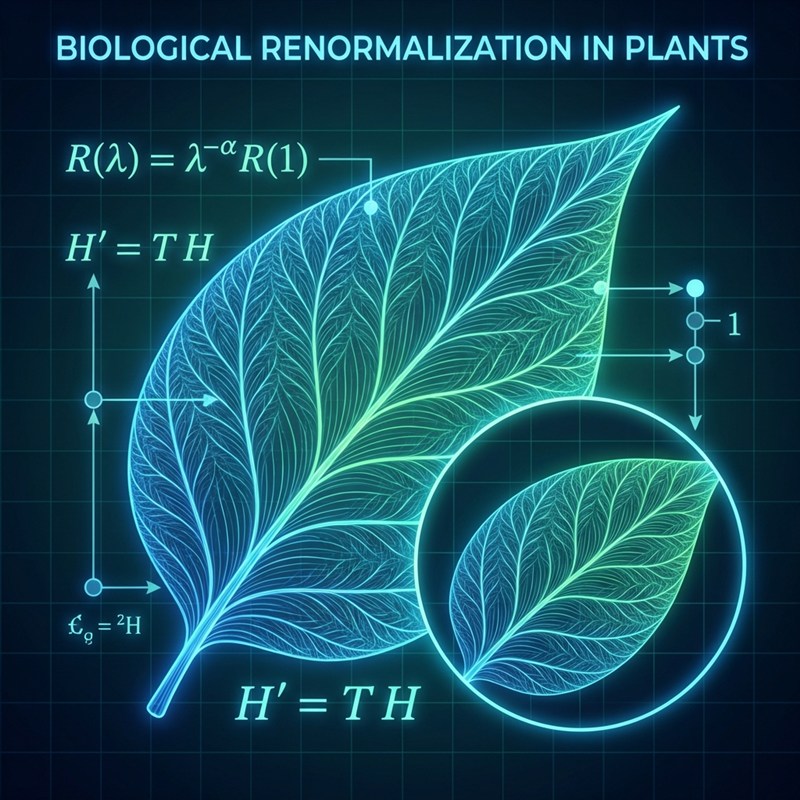
In physics, 'Renormalization Group' is a mathematical technique used to connect the micro world (quantum mechanics) with the macro world (classical mechanics). We apply this to plant modeling.
Core Idea
Simulating each individual plant cell ($10^{12}$ cells) is impossible. However, the 'Emergence Pattern' created by collective cell behavior can be expressed in simple equations. Instead of solving biochemical equations at the cell level, we derive new Effective Equations that define the behavior of a single 'Meta-Cell' that bundles 1,000 cells together.
Application in AgSharp
Instead of computing the entire leaf, AgSharp performs ultra-precise simulation on a single virtual 'Representative Leaf' that perfectly follows biochemical mechanisms. The remaining leaves mathematically replicate (Scale) the state of this representative leaf, reducing computational load by 1/1,000,000.
Adaptive Level of Detail
"Look closely only when needed (Focus of Attention)"
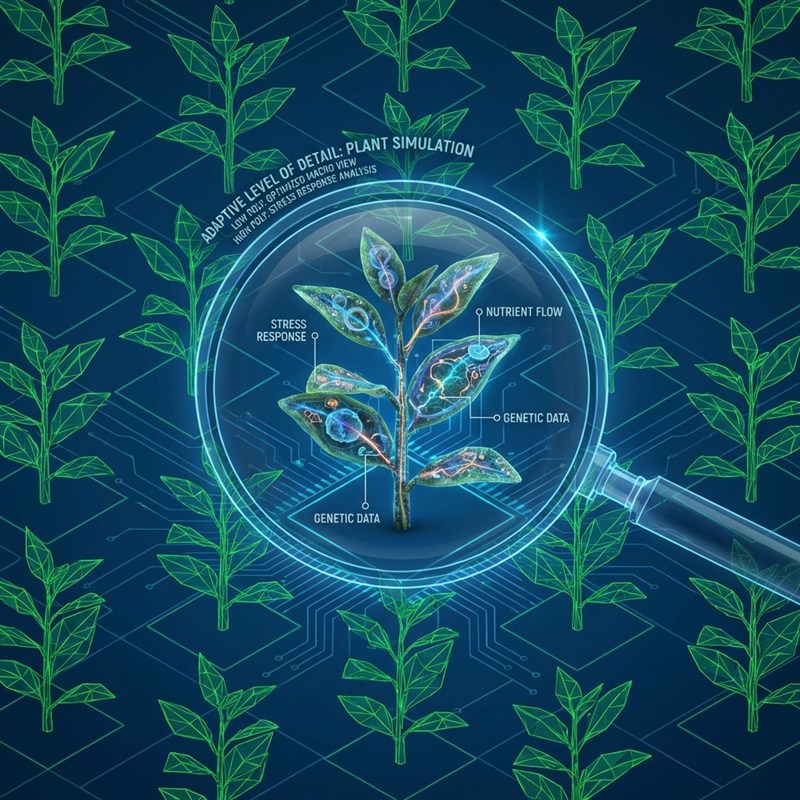
3D game engines render distant mountains as simple images while rendering nearby characters with tens of thousands of polygons (LOD technology). We apply this to biological time.
Core Idea
When plants are growing peacefully (Normal State), calculations are done quickly using lightweight empirical models (AgSharp Basic). But the moment a 'Stress Event' such as drought, pest damage, or rapid temperature change is detected, the system "Zooms In". Only at that moment does it locally activate a heavy biochemical model (Biochemical Engine) to precisely calculate down to enzyme reaction stages.
Application in AgSharp
"Hybrid Engine Architecture": Normally running at 100 km/h, but pulling out a microscope only when precision parking is needed. This approach captures both efficiency and accuracy.
Knowledge Distillation & Shadow Model
"The student learns the master's intuition (Intuition Transfer)"
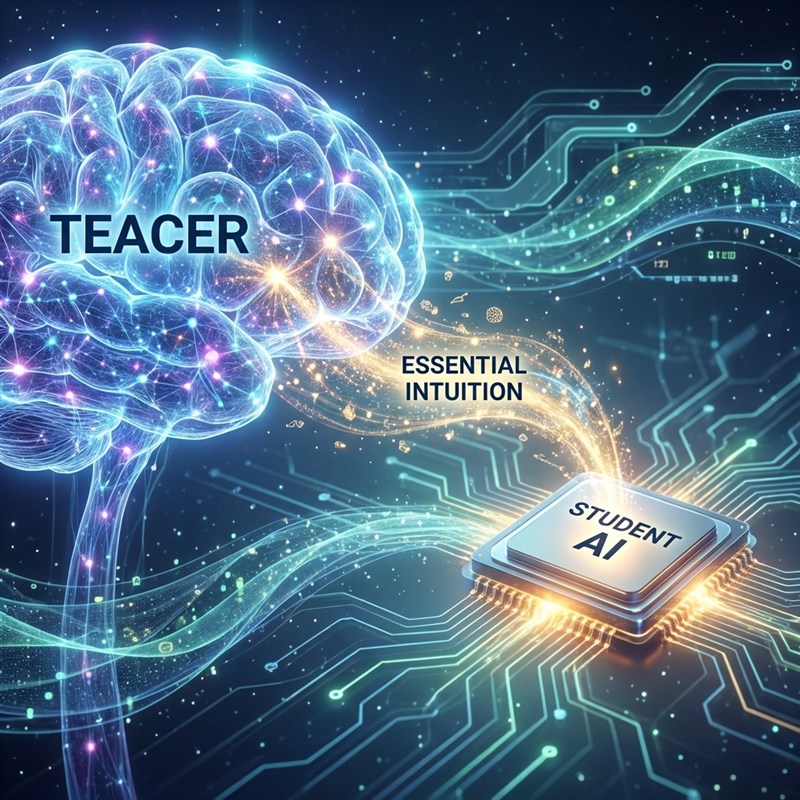
The most realistic yet powerful AI approach. Rather than directly running a heavy biochemical model, we create a lightweight AI that mimics only the 'behavioral patterns' of that model.
Core Idea
- Teacher Model (Master): A perfect biochemical simulator running on a supercomputer with massive computation but 99.9% accuracy.
- Student Model (Student): A lightweight neural network to be deployed in AgSharp.
The Teacher model performs tens of thousands of years of virtual simulations, and the Student model learns through deep learning only the input/output patterns (intuition) of "why the teacher produced those results in that situation."
Application in AgSharp
Eventually, all heavy biochemical formulas can be stripped away, and a lightweight AI (Student) that has learned only the 'intuition' produces results inside AgSharp with the same accuracy as the biochemical model, but 1,000 times faster.
Bio-Hybrid Computing
"Nature itself is the best computer (Nature is the Computer)"
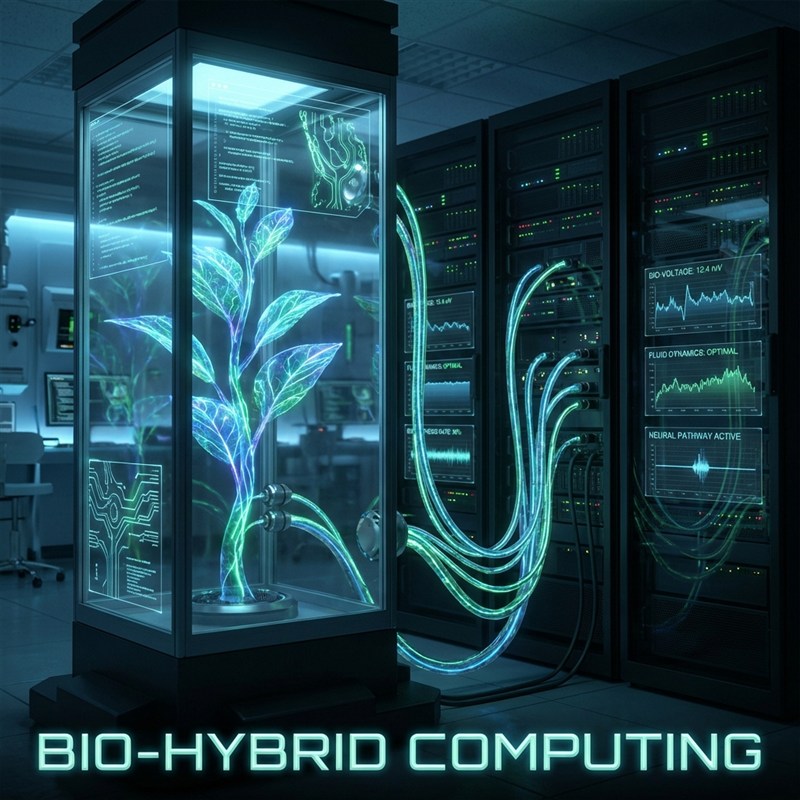
This flips the very concept of simulation. No matter how good a supercomputer is, it cannot calculate photosynthesis efficiency faster than a chloroplast.
Core Idea
Don't try to compute complex biochemical reactions on a computer.
Actually grow Reference Plants at the OAS data center and attach ultra-precise sensors to them.
When a user asks "what happens to biochemical reactions when the temperature is 30°C?", instead of computing it, we change the actual plant's environment in the data center to 30°C.
Then we read the plant's real-time biological responses (electrical potential, stem contraction, etc.) and transmit them to the user.
Application in AgSharp
"Using plants as Co-processors": 'Outsource' the unknown realm of biochemical reactions to actual plants, while AgSharp only calculates yield from those results. This is the ultimate model with computational efficiency of 0 (nature handles it) and 100% accuracy.